(Thanks to Anna, Alain & Lucy for helpful comments on an earlier version of this post)
It was a beautiful Saturday morning. I woke up, peeked out the window, and noting that the weather was beautiful, set out for a run along my usual route along the west side highway.
As I ran past the parks where dads chased their kids – a look of pure joy on the little one’s faces; past the water fountains, the great equalizers, where runners – young or old, fast or slow, marathoners or newbies, took a break; past the jersey shoreline – oh so pretty, with memories of a past life I lived across the river, with warmth as I was reminded of the friends across that metaphorical divide; I thought of life’s trivialities.
I thought of hobbies and entertainment. Of crushes and vacation. Of food and song. Fun thoughts. Thoughts that I hadn’t had a chance to think about in a while. And in all honesty, thoughts that were trivial in the grand scheme of things. And as my heart rate rose and I reached my lactate threshold, I thought about these thoughts.
And in that moment, I couldn’t help but feel grounded and grateful – grateful for the opportunities I was afforded, the mentorship and advice I’d received, and the bets on myself that happened to work out. Grateful I could worry about such trivialities. And I reminisced on turning 26.
I’ve been bad about writing; and I’ve always wanted to write about turning 25. However, the timing didn’t feel right; it felt like there was a piece of the puzzle I hadn’t figured out. And at 26, I don’t think I’m done just yet – but I feel ready to write this.
So, what do I have to show for all those years spent orbiting the sun? Honestly, there’s a lot I want to write about. But for now, I’ll write about three punchlines; they seem obvious in retrospect, but the details turned out more complicated than I expected looking back.
Make decisions you won’t regret
“Your time is limited, so don’t waste it living someone else’s life’’
Growing up in India, I was taught to ask my elders for advice – on everything from career choices to whether I should keep the ceiling fan on at night. While I continue to believe that it’s worth asking advice from peers and mentors on topics you believe they might be particularly insightful at, I’ve realized that it’s on you to make decisions that you won’t regret [1].
I’ve regretted saying “okay” rather than pushing back against decisions that didn’t feel right; as an example that felt big to 10th-grade-me, being told I probably wouldn’t qualify for math camp and should focus on doing well at school was devastating. What’s more – despite minimal preparation, I came within an inch of making it, and when I heeded no “helpful advice” the following year I made camp by a large margin. As another example, relationship advice I’ve gotten has often been colored with personal biases. I believe advice-giving is often good-natured; you also need to understand where they’re coming from, what their experiences they’re basing advice off have been, and whether they apply to your situation.
Another similar situation is societal pressure; a way this shows up is the pressure to not fail. My hypothesis is this view is imbibed from cultures that were traditionally poor, and thus is significantly more common in the east compared to the west. This makes sense, since when you have little and no social security net, losing your livelihood can be the final blow (ala Kelly criterion); this is often not the case for many families nowadays, but this viewpoint hasn’t updated at the same pace.
Another common way this shows up is the pressure to have work-life balance, or to have a structured schedule. My philosophy has roughly been to do things that make you feel happy or fulfilled; sometimes, that’s hobbies and I spend a lot of time on them, and many times that’s working; it’s always felt weird to me to force yourself to stop working at 5pm or 6pm; I get up when I’m mentally done and I want to get dinner with friends, or want to play badminton, or write. The lesson here is to give yourself permission to be free.
And lastly, don’t let appearances fool you into giving up your whimsical self. Sure, institutions are supposed to be logical, but unfortunately humans are innately irrational beings. Go believe in something, get disproportionally excited about the halloween party this year, or the new peanut butter spread that’s hitting supermarket shelves this week. Stay young at heart by nurturing your inner child 🙂
[1] One reason you have an advantage over advice-givers is private information and context. Your uncle might tell you making the olympic track team is impossible – until they learn your 100m time is 10 seconds flat. There’s other factors at play too, of course; it’s not just the context of the situation, but people care differing amounts about hobbies vs careers vs relationships, for example – the full context of how much each decision means to you. Advice is rarely “wrong”, just miscalibrated; people give advice placing themselves in your shoes, which is not the same as you in your shoes.
Be levered yourself
“If you don’t believe in yourself, who will?”
I’ve found that the things I can do and learn often eclipse my imagination in a few different ways, which I collectively call the concept of “levering” – putting myself in situations and giving myself the opportunities to amplify my strengths and dampen my shortcomings.
The first way comes from passion: I’ve found that indulging my curiosity deeply in hobbies or tasks often leads to lower wall-clock time spent with high quality outputs and understanding. As a concrete example, I was never a fan of chemistry, including organic chemistry; however, I managed to convince myself that solving organic reactions was similar to logic puzzles (Will the elimination reaction obey Zaitsev’s rule or Hoffman’s rule? Will the carbocation rearrangement be SN1 or SN2?), that made this “chore” a much more productive learning process.
This “self-hypnosis” process of being curious about something is great; for instance, it allows me to support and be interested in my loved one’s hobbies! Another important corollary here is to surround yourself with passionate individuals; you get to grow with them.
The second way comes from efficiency; ie, Parkinson’s law flavored feats. A lot of adulthood for me has been about understanding the tendencies I have, and how to harness them in the best way; an example under this bullet is, ironically, societal pressure; I’ve learned public accountability is a stronger motivator than caffeine. If there’s a feat I think I can do but lack the motivation, I tell people I’m going to do it (and even more specifically, on X date). For instance, I bet someone I’d run multiple marathons this year, having previously never run more than 10 kilometres – and I did (but that’s a story for another time..)
The third (and final, for this already-long post) way comes from agency: “what would a person with 10x my agency do?” Agency has been a popular discourse in recent times, but I want to emphasize a corollary of thinking in this way – if you truly want to live your life like you have 10x the agency and ability, you need to treat your time accordingly.
As a result, I’ve made changes in my lifestyle over the past year to account for this; I pay a premium for better health, lower stress and convenience; I’ll take a cab or order delivery if I’m tired; I try to be intentional about the events I go to; and maybe one of the best investments I’ve made on my time is getting (often personal) coaching for things I want to get better at, such as singing, badminton or yoga.
Build relationships that matter
“We’re all just walking each other home.”
A few months ago, a friend asked me how I’d been. I realized I hadn’t answered that question honestly in years.
It might seem like a no-brainer; but yet it deserves saying that our relationships are what make us human. I value being surrounded by people who have differing worldviews; different opinions, interests, different paths in lives, and thus I’ve gravitated toward New York as a home – and yes, I’ve loved this part of the city. On the other hand, sometimes it felt like New York connections were more superficial; the true sparks were more fleeting, transient, diluted. I’ve realized that going to events every other day making small talk isn’t what I want; instead, I want to be intentional with my time.
Ironically, I’ve come to enjoy the same events I used to be unenthused about from this perspective shift; being honest, direct, and unguarded has made me enjoy and appreciate those 5-minute conversations with someone I’m never going to see again. I’ve been doing improv for over a year now, and it’s been very additive to my experiences; it’s taught me that the best conversations begin with a “yes, and”; and that listening, really listening, is important.
When it’s time for real talk though – I’ve realized one of the most important concepts around relationships is reciprocity. The last few years have been heavy in ways I didn’t fully acknowledge, and without realizing it, I stopped sharing what was happening in my life while continuing to be the “therapist” friend. It took some reflection and soul searching to realize that my thoughts were becoming mysterious to the people that knew me best. Feelings beget feelings. One last thread I want to pick up again this year is personalized gifting – something I used to enjoy and pride myself in; small, intentional gestures to bring people closer.
Conclusion
Thinking back to that run along the hudson, life feels similar – moments of reflection between heartbeats, flashes of gratitude between gasps of breath. To friends (many younger than me), I joke about getting old and frail. But the truth is – I’m still running.
I’m in the best shape of my life, curious as ever, and excited for what’s to come.
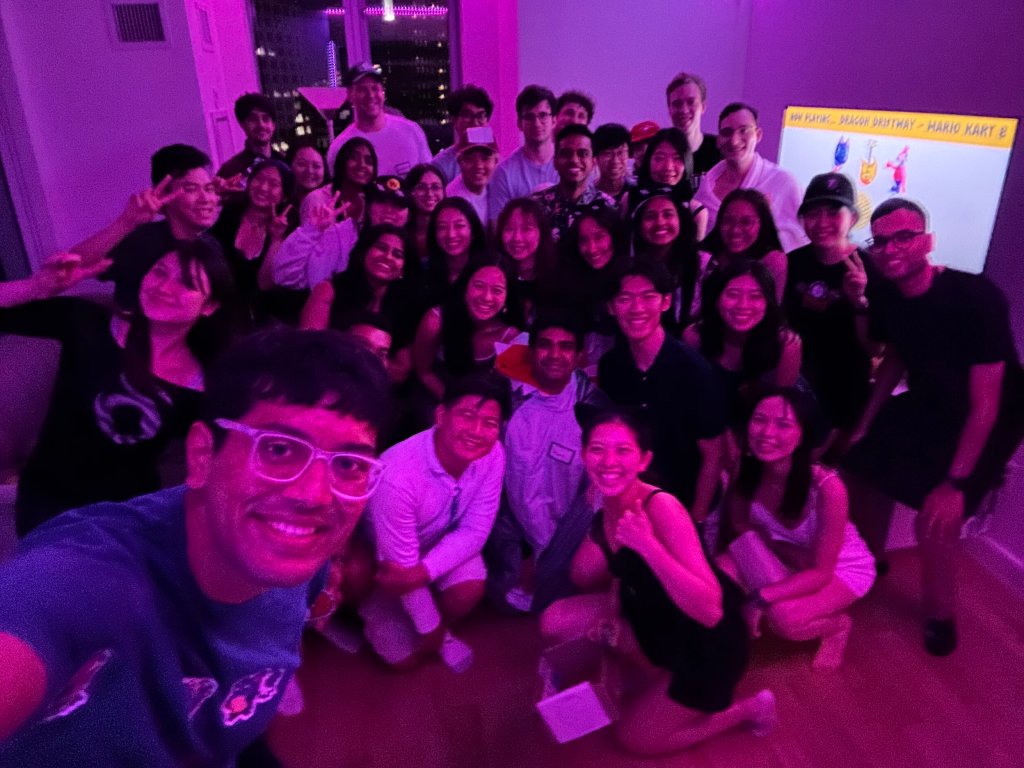
So here’s to 26 – to good health, brave bets, and to the amazing humans by my side :))
 These Stray Thoughts
Leave a comment